
AI search optimization, built on SEO that holds up.
We help Google's AI features, ChatGPT and Perplexity find, read and describe your business correctly. The work happens on your website and across your web presence, and we don't promise placement in any AI answer.
- How it's sold
- Part of SEO Management, from $99 a month
- How it's monitored
- A manual, dated prompt log, not an automated score
- What we won't promise
- A place in any AI answer
What AI search optimization is.
AI search optimization makes your business easier for AI-assisted search tools to find, understand and cite accurately. It builds on technical SEO, content quality and a strong web presence, and it doesn't replace them. No special markup guarantees visibility.
- AEO (answer engine optimization)
- Structuring pages so a direct question gets a direct answer that is easy to quote.
- GEO (generative engine optimization)
- Making your business easy to find and describe correctly for tools that write their own answers. Both are industry labels, not official programs.
- Google AI Overviews and AI Mode
- AI features inside Google Search. Your pages appear in them through the same indexing as regular Search.
- ChatGPT and Perplexity visibility
- Whether these tools can reach your site, and whether their answers mention and link to you. Each has its own crawlers.
Each layer rests on the one before it.
If a page can't be crawled, the quality of its writing won't matter. If the writing says nothing specific, consistent listings won't save it. That is why we start at the bottom of the stack.
-
1. Technical SEO
Pages can be crawled, indexed and loaded, and the important content is available as text.
-
2. Content quality
Helpful, reliable pages written for people, with direct answers and original knowledge from your business.
-
3. A strong web presence
The same business details everywhere, a current Business Profile, and mentions from sources people trust.
-
4. AI visibility
What you hope to get from the first three. It can be earned and watched, but no one can switch it on.
Six things we actually do.
Crawlability and content accessibility
We check that robots.txt, your CDN and your hosting don't block the crawlers you want, and that key information is real text instead of being locked inside images.
Entity consistency
Your business name, address, phone, services and profiles should match across your site and listings, so systems reading them can tell they are all you.
Structured information
Clear headings, direct answers, tables and FAQs, plus structured data that matches the text on the page. It helps a reader or machine follow the page. It is not a pass into AI answers.
Content authority
Pages that cover a topic properly, link to their sources and connect to each other through internal links, instead of thin pages written to fill a keyword list.
Original expert content
Things only your business can say: your process, your prices, your local knowledge and your answers to the questions customers actually ask. We write it with you.
AI citation and brand mention monitoring
A manual, dated log of what AI tools say about you, which pages they cite and what they get wrong, so the next round of work has a reason behind it.
What the platforms publish, and what we check.
We read the source documentation instead of relying on rumor. This summary reflects each page as we read it in November 2026. These policies change, so we check them again when we do the work.
| Platform | What its documentation says | What we check for you |
|---|---|---|
| Google AI Overviews and AI Mode | No additional requirements or special optimizations. A page must be indexed and eligible to show with a snippet, which still doesn't guarantee it appears. No special schema or AI text files are needed. Google's guide (opens in a new tab) | Indexing and snippet eligibility, that robots.txt and your CDN allow crawling, internal links, important content available as text, and structured data that matches the page. |
| ChatGPT search | OAI-SearchBot surfaces sites in ChatGPT's search features, and sites that opt out won't appear in its search answers, though they may still show as navigational links. GPTBot relates to model training and is controlled separately. OpenAI's documentation (opens in a new tab) | That your robots.txt reflects the choice you actually made for each crawler, and that nothing else is blocking them by accident. |
| Perplexity | PerplexityBot surfaces and links sites in Perplexity results, and Perplexity recommends allowing it in robots.txt and permitting its published IP ranges. Perplexity-User handles visits a person triggers and generally ignores robots.txt. Perplexity's documentation (opens in a new tab) | Your robots.txt rules and any firewall or hosting settings that could stop PerplexityBot from reaching the site. |
Access is a precondition, not a result. Allowing a crawler makes it possible for your pages to be used. It doesn't mean they will be.
What you may be told, and what we'd tell you instead.
| You may hear | Our answer |
|---|---|
| "You need AI schema to show up." | Google says no special schema.org structured data is required for its AI features. We use structured data to describe a business accurately, not as a way in. |
| "You have to add llms.txt." | It is optional and experimental, and it isn't a Google requirement. Google says you don't need new AI text files for its AI features. |
| "We can get you into ChatGPT." | No one outside those companies controls what the tools choose to say. We can make your business easier to find and describe correctly, and we report what we see. |
| "Here's your AI visibility score." | We don't sell one. Answers can change from one ask to the next, so we would rather show you dated examples you can read for yourself. |
A dated log you can read, not a score.
We run an agreed list of customer-style questions by hand and record what comes back. It is a sample rather than a measurement of everything, and we present it that way.
Google counts traffic from its AI features in your overall Search Console web data, so we read that alongside the log.
What each log entry records
- Date
- When we ran the prompt. Answers change, so an undated result tells you very little.
- Tool
- Google AI Overview or AI Mode, ChatGPT search, or Perplexity.
- Prompt
- The question as a real customer might ask it, agreed with you in advance.
- Mentioned?
- Whether your business was named, and who else was.
- Cited pages
- Which pages the answer linked to, on your site or anywhere else.
- Accuracy
- Anything the answer got wrong, such as old hours or a service you don't offer.
- Next step
- What we would change on your site or listings because of it, if anything.
How to buy it.
This work is part of SEO Management today, starting at $99 a month as an add-on on our hosting plans, which start at $25 a month. The monthly plan is written for Google and for AI search tools such as Perplexity and ChatGPT, because the same pages and the same fixes serve both.
If your site has bigger problems, such as crawl blocks or thin content, we will say so and quote that work before starting it.
Pages written to be read and understood
These show the kind of clear, well-organized content this work depends on. They are not a claim that any of these sites appears in an AI answer.
 Healthcare
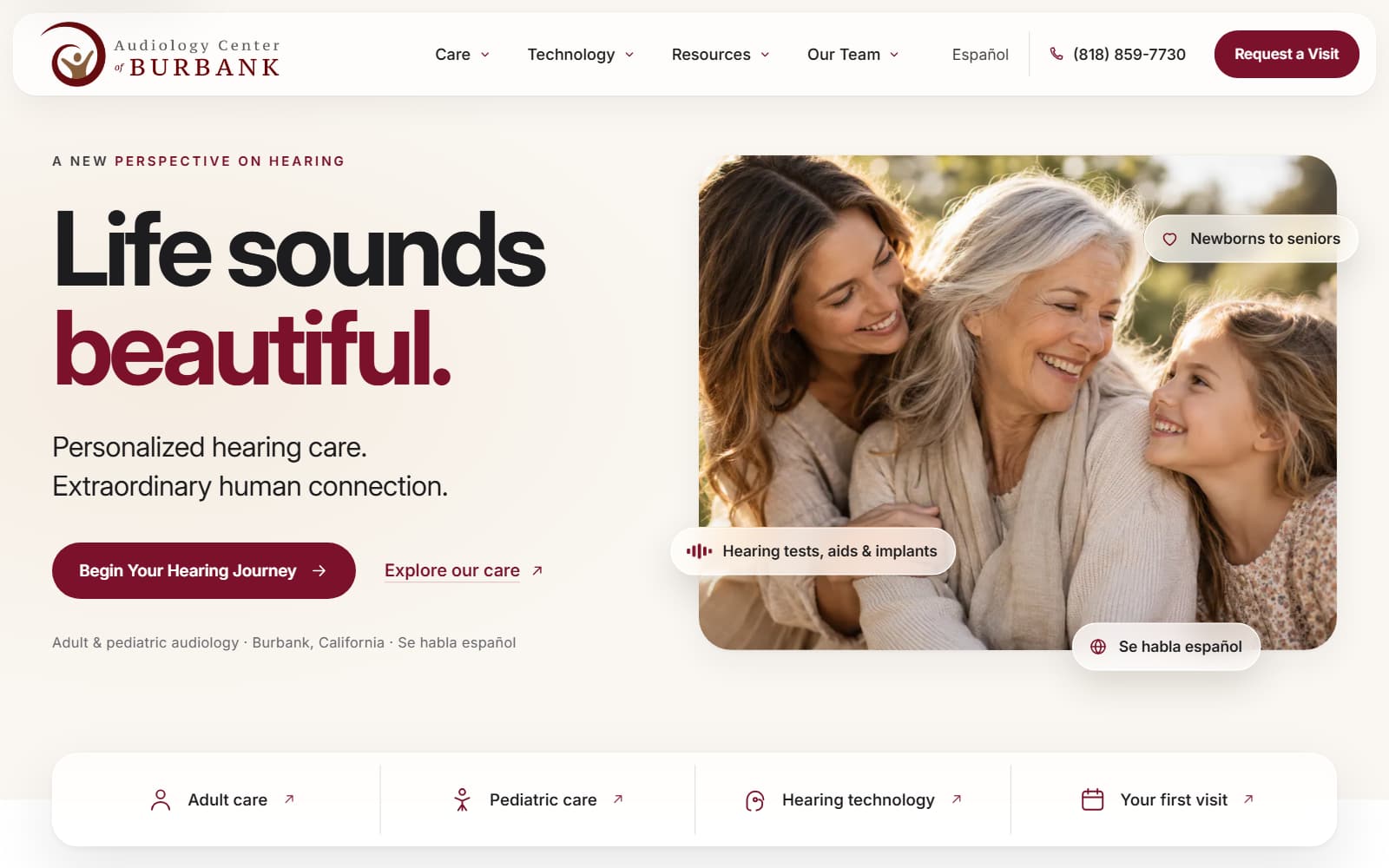
Audiology Center of Burbank
Long patient guides with clear outlines, sources credited to the NIDCD, a searchable library, and structured data that describes the practice and its address.
Read the case study → Nonprofit housing
Burbank Housing Corporation
Plain answers to the questions applicants actually ask: income categories, waiting lists and how to apply, with an FAQ page and consistent contact details.
Read the case study →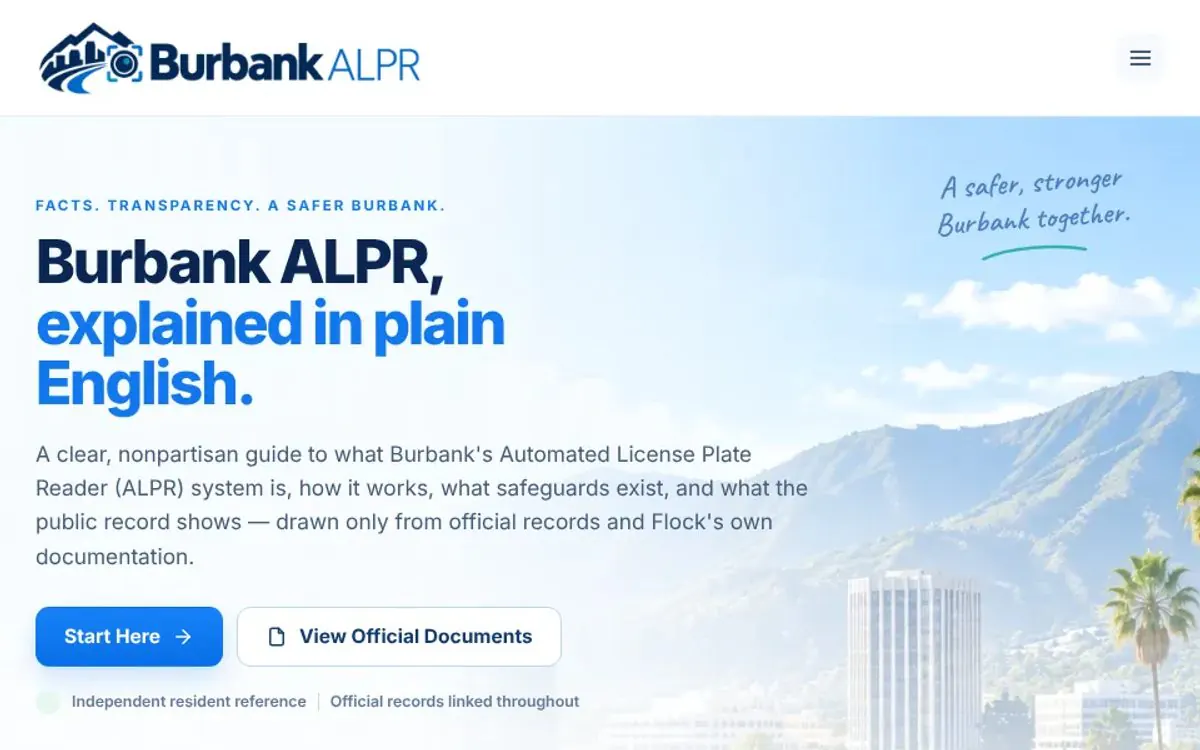 Civic
Burbank ALPR, Explained
A plain-English, nonpartisan guide to Burbank's license-plate-reader program, written from the public record. Live on a preview domain while its custom domain is pending.
Visit the live site → (opens in a new tab)Founder-led and based in Burbank since 2021. You work directly with the people doing the work.
Straight answers.
No, and no one can guarantee it, because those systems decide what to show and their answers change. We can improve the things they rely on, such as access, clarity and accuracy, and then show you a dated record of what they say about you.
AI search optimization is mostly SEO with extra checks, not a replacement for it. It rests on the same technical SEO, content quality and web presence, then adds crawler access checks and a prompt log for AI tools. Our article on SEO vs. AI search goes further.
No, Google says there is no special schema.org structured data you need to add to appear in AI Overviews or AI Mode. Structured data is still useful for describing your business, as long as it matches the text on the page. Read Google's guidance.
No, you don't need one for Google, and we treat llms.txt as optional and experimental. Google's guidance says you don't need new machine-readable or AI text files to appear in its AI features. If you want one, it is a small addition, but we wouldn't count on it to change anything.
It is part of SEO Management today, which starts at $99 a month as an add-on on our hosting plans. We don't sell it as a separate package, because the same work serves both. See SEO services for what else is included.
We measure it with a manual, dated prompt log, not an automated rank score. We run an agreed set of questions in each tool, then record whether you were mentioned, which pages were cited and what was wrong. It is a sample of what those tools said on that day, and we report it as that.
That depends on what you want, and you can often decide crawler by crawler. OpenAI, for example, treats OAI-SearchBot, which relates to ChatGPT search, separately from GPTBot, which relates to model training. So you can allow one and block the other. See OpenAI's crawler documentation.
Not as its own number: Google says traffic from its AI features is included in your overall Search Console data, under the Web search type. It is counted together with the rest of your web search traffic, which is one reason we keep a separate prompt log.
Curious what AI tools say about your business?
Tell us the questions your customers ask. We will talk through what we would check first, and be upfront about what no one can control.