
A website redesign that doesn't start over in search.
We modernize how your site looks and works while protecting the URLs, content and search signals it has already earned, with a written redirect map and a plan that runs past launch day.
A redesign is two projects.
A redesign changes what people see, and a migration changes where everything lives. Search trouble after a relaunch usually comes from the second one: pages that moved without a redirect, or content that was dropped. We plan both together, before the design starts.
Not sure where your site stands? Start with a free website audit.
Nine steps, from inventory to after launch.
The order follows Google's guidance on site moves with URL changes (opens in a new tab), with the design and build work placed around it.
-
Inventory the current site
We list every page that matters, using your sitemap, Search Console, analytics and the CMS. We also note which pages already bring in search traffic, so they don't get lost in a design conversation.
-
Decide what stays, merges or goes
Each page is marked keep, improve, merge or retire. Good content that is working stays. Retiring a page is a decision made on purpose, with somewhere sensible for its visitors to go.
-
Redesign the experience
New UX and UI built around what visitors need to do, designed for phones first. You review layouts while changes are still easy to make.
-
Build it, and add what the old site could not do
We build in custom code or Wix Studio, watching load time and accessibility from the start: keyboard use, contrast, zoom and reduced motion. Custom development covers the features a site builder won't handle.
-
Migrate the content
Text, images, documents and metadata move to the new structure, with page titles and headings reviewed on the way across. How much we move for you is set in your proposal.
-
Write the redirect map
A spreadsheet that pairs each old URL with its new home. Every redirect is a permanent server-side redirect and goes straight to the final page, with no chains.
-
Check everything before launch
You preview the full site. We test forms, calls to action, redirects, mobile layouts and the conversion paths visitors will actually use.
-
Launch day
The site goes live on your domain and the redirects turn on with it. We submit the new sitemap in Search Console. If the domain itself is changing, we also use Google's Change of Address tool.
-
Watch what happens next
We monitor indexing, crawl errors and search performance for both old and new URLs, and fix anything the move shook loose. Google recommends keeping redirects as long as possible, generally at least a year.
A note on expectations: Google says to expect temporary ranking fluctuation during a move while it recrawls and reindexes the site. Good planning limits the damage, but it doesn't make a move invisible. Our article on redesigning without losing rankings goes into more detail.
What it looks like in practice.
A redirect map is a plain spreadsheet, and it is one of the most valuable documents in the project. These rows are an illustration, not a real client's site.
| Old URL | Decision | New URL | Why |
|---|---|---|---|
| /services.html | Keep the page, new address | /services/ | Same content on a cleaner URL, so a permanent redirect. |
| /about-us/ | Keep as is | /about-us/ | It already works, so there is no reason to move it. |
| /blog/2019/spring-tips | Merge | /guides/seasonal-care/ | Two thin posts become one useful guide, and both redirect to it. |
| /summer-sale-2021 | Retire | /offers/ | The offer is over, so visitors go to the closest current page. |
Everything a redesign has to get right.
- UX and UI modernization
- Clearer navigation, stronger first screens and layouts that fit how people use the site now.
- Existing SEO preservation
- URLs, titles, headings and content that already perform are identified and kept or redirected.
- Migration planning
- A written plan and order of work, agreed before anything moves.
- Redirect mapping
- One-to-one mapping from old URLs to the closest new page.
- Mobile responsiveness
- Designed for phones first, then checked on tablets and desktops.
- Performance
- Lighter images and code, with load time checked before launch.
- Content migration
- Pages, media and documents moved and tidied, scoped in your proposal.
- Conversion optimization
- Calls to action, forms and contact paths placed where visitors need them.
- Accessibility
- Keyboard use, contrast, zoom and reduced motion planned in, not patched on.
- Custom development
- Features built properly when a template or plugin won't do the job.
Scoped like a new build, with one fixed price.
Your proposal lists the pages, the migration work, the timeline and a single price. As a guide, our calculator estimates $2,300 to $2,900 for up to 5 pages on a proven template and $4,100 to $5,200 for 6–10 pages with a custom design. Most small-business sites take 3–6 weeks.
Redesigning a store or a web app? See ecommerce website design or web app development.
Redesigns and relaunches you can visit
We don't publish before-and-after traffic or ranking figures for these projects. You can see the sites themselves.
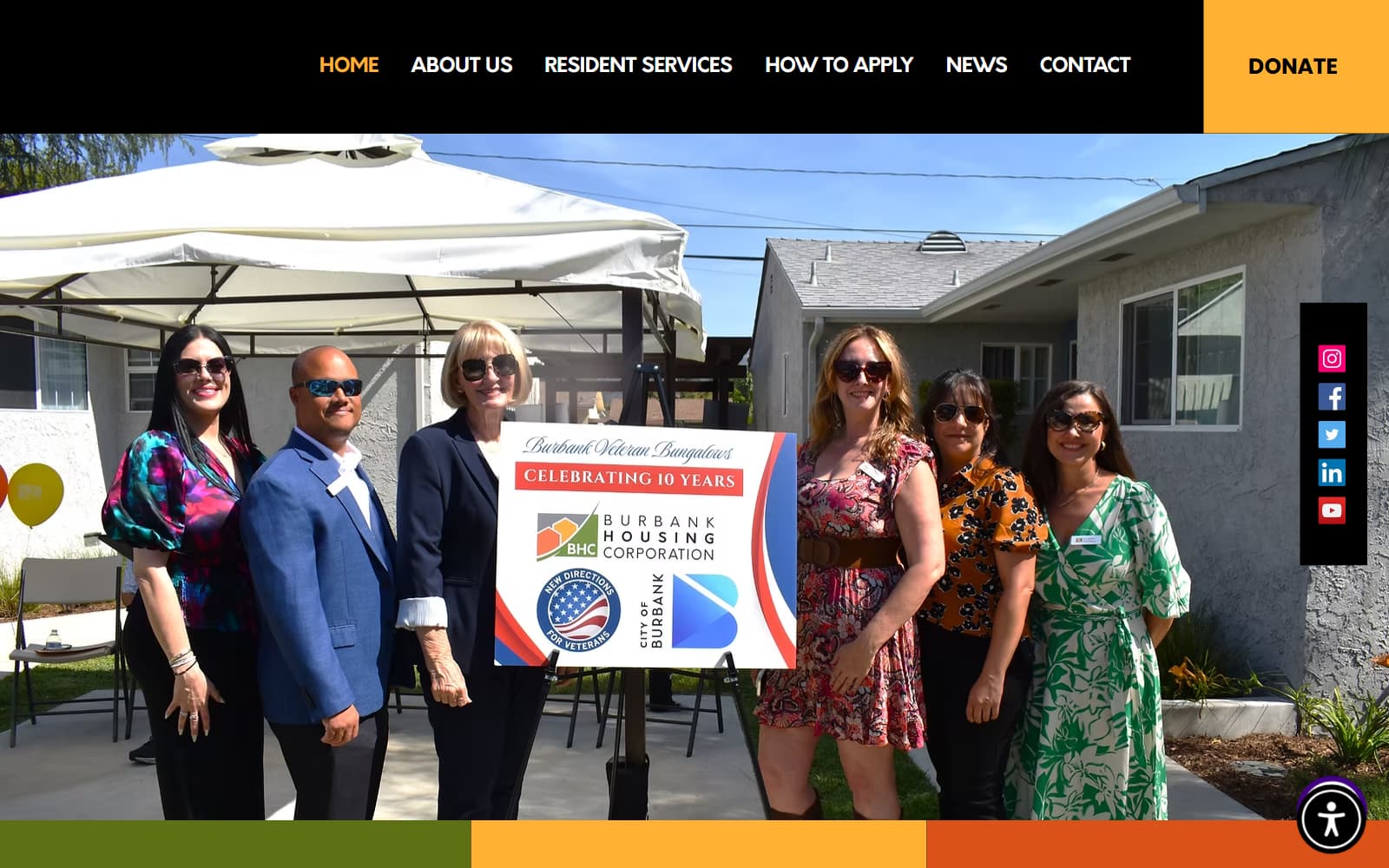 Nonprofit housing
Burbank Housing Corporation
A website changeover and relaunch for a Burbank affordable-housing nonprofit, with how to apply, waiting lists, an income-level calculator and resident services.
Read the case study → Retail
Burbank Ammo & Guns
A redesign launched on burbankguns.com in October 2026 for a family-owned Burbank store, with current promotions, consignment and store hours easy to find.
Visit the live site → (opens in a new tab)Founder-led and based in Burbank since 2021. You work directly with the people doing the work.
Straight answers.
It can if URLs change without redirects or good content gets dropped, which is why we plan the move before we design anything. Even a well-run move can cause temporary fluctuation while Google recrawls the site, and Google says so itself. No one can promise rankings won't move. What we commit to is the plan and the follow-up.
No, and keeping a URL that already works is usually the safest choice. We change a URL when there is a real reason, such as a structure that no longer makes sense, and every change gets a redirect to the new page.
Keep them for as long as you can, and generally for at least a year, which is Google's published guidance. Other sites may keep linking to your old URLs long after that, so we usually see no reason to remove working redirects.
A redesign is scoped like a new build, with one fixed price in your proposal. As a guide, our calculator estimates $2,300 to $2,900 for up to 5 pages on a proven template, and $4,100 to $5,200 for 6–10 pages with a custom design. Content migration is scoped in the proposal, and our guide to website cost covers what moves the number.
Most small-business sites take 3–6 weeks from the start of the build, online stores 6–10 weeks and web apps 8–14 weeks. A larger migration takes longer, and Google notes it can take a medium-sized site several weeks to settle in search after the move, so we plan for follow-up after launch.
Yes, we start from the live site and your accounts, not from the original files. We will need access to your domain, your hosting or website platform, and Search Console if you have it. If you are not sure who holds those logins, we can help you work it out.
Yes, we build in both custom code and Wix Studio, so we can move in either direction once we know what the site needs to do. A platform change usually means URLs change, so it gets the same redirect map and checks. Our Wix Studio vs. custom code guide can help you decide.
Fix what you have if the site is sound and the problems are limited to content, speed or a few pages. Redesign when the structure itself is in the way, the site is hard to use on a phone, or it can no longer do what the business needs. If a redesign isn't the right call, we will tell you.
Keep exploring
A closer look at how to protect search traffic when your site changes.
Ongoing technical, on-page and local SEO for after the new site is live.
Starting fresh instead? How we design and build new sites, and what they cost.
Thinking about replacing your current site?
Send us the address. We will look at what it does well, what is holding it back, and whether a redesign is really the right move.